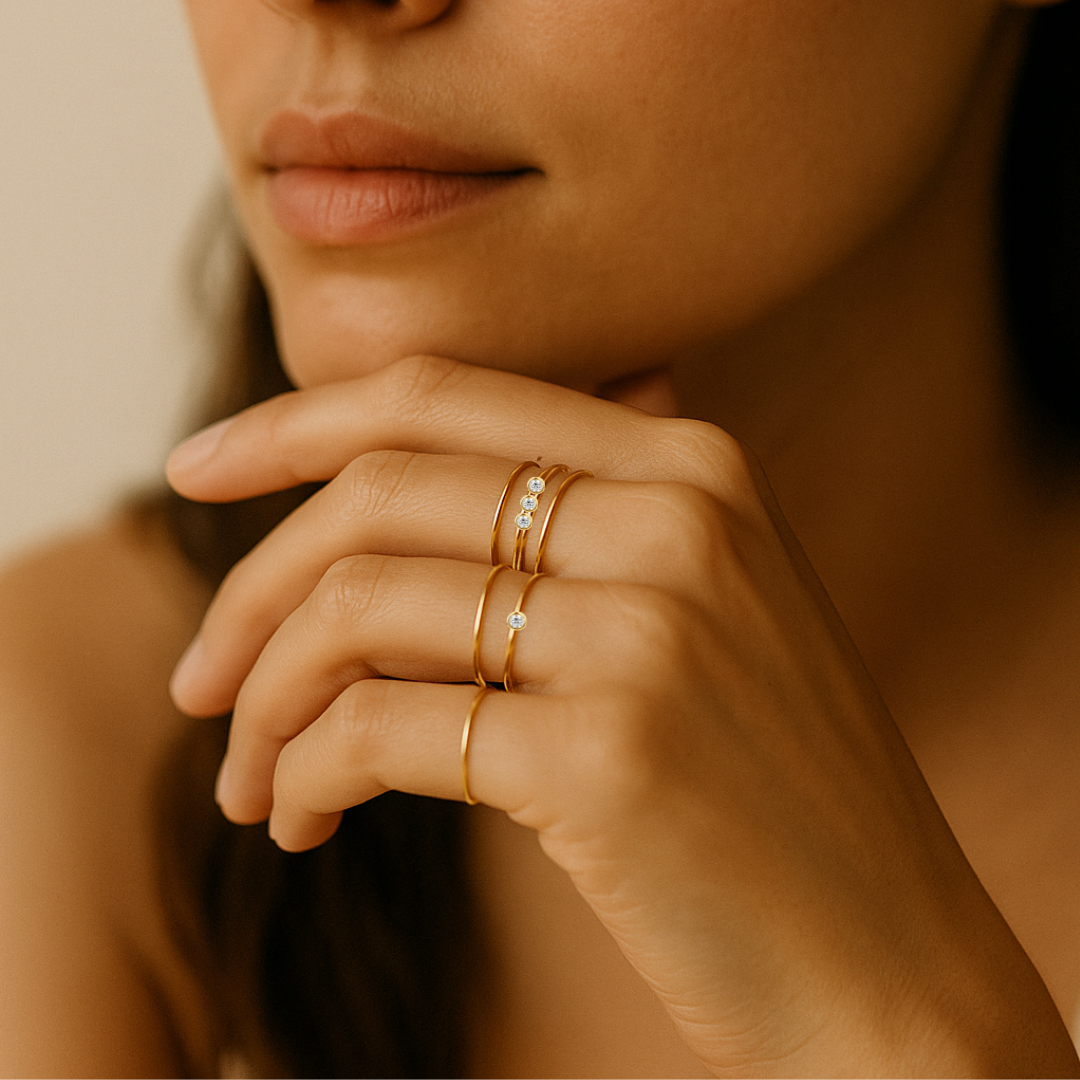
20% off Stacking Rings
Mix & Match!
Enjoy 20% off when you purchase 3+ rings with code STACKTHREE..
STACKTHREE


Gold earrings are the accessory you forget you’re wearing, until a mirror shows how a small flash of gold sharpens a plain T-shirt. They are often the first real jewelry a woman buys and the pair she reaches for most, because they work with denim on Saturday and a blazer on Monday.
Choosing them is trickier than it looks. Sizes come in millimeters that are hard to picture, labels like gold filled, vermeil and plated sound alike but wear very differently, and a pair that looks perfect online can feel heavy by mid-afternoon. This guide clears that up, from styles and sizes to gold types, face shape and the mistakes worth avoiding.
Few accessories work as hard as a good pair of gold earrings. The same small hoops can go from a school run in jeans to a client meeting in a blazer to dinner in a slip dress without looking out of place. Because they sit right beside your face, earrings are also the piece people notice first, whether across a table or on a video call.
Gold has staying power, too. Pure gold doesn’t rust or corrode, which is why gold jewelry thousands of years old still gleams in museum cases. Its warm glow suits a wide range of skin tones and pairs with any wardrobe color, from black and navy to cream and bright prints, so you rarely have to plan an outfit around it.
The real test of an everyday pair, though, is comfort. An earring you love but remove by lunch isn’t an everyday earring, so the sections below weigh how each style looks and how it feels after eight hours.
Most everyday collections are built from six styles. Here’s what sets each apart and when it works best.

Stud earrings are a single point of gold that sits flat on the lobe, held in place by a post and a back. They are the most popular earring type for good reason: they rarely catch on hair or sweaters, suit every dress code, and are the easiest style to sleep in.
The back matters as much as the front. Push backs (also called butterfly backs) are quick to use but loosen over time; screw backs thread onto the post and stay put; flat-back studs, common in cartilage piercings, have a flat disc behind the ear that is comfortable on a pillow. If your stud has a stone, a bezel setting, where a rim of gold surrounds the stone, snags far less than prongs.

Hoops are the backbone of most collections, and size changes their personality entirely. Small hoops (10–15mm) are understated and suit second piercings. Medium hoops (19–29mm) are the most versatile, polished enough for work and relaxed enough for weekends. Large hoops (35mm+) make the outfit and come into their own with updos, evenings and vacations.
Look at the closure as well as the size. Endless hoops use a thin wire that slides into the tube for a seamless look; hinged or click-top hoops snap shut and are the easiest to put on; latch-back hoops hook into a catch and are the most secure in bigger sizes. Tube thickness shapes the look too: around 1–1.5mm reads delicate, while 3mm and up reads bold.
3. Gold Drop Earrings
A drop earring hangs a short, fixed distance below the lobe, so it moves less than a dangle. Teardrops, pearl drops, small bars and stone pendants all belong here. That gentle movement catches light near the face, which is why drops suit dinners, events, weddings and dressier outfits.
Short drops that sit within an inch or so of the lobe can work every day, especially with your hair up. Longer or heavier drops are best saved for occasions, since they pull on the piercing over a full day.

Huggies are small, thick hoops that sit snugly around the lobe with almost no gap. Because nothing dangles, they don’t catch on scarves or headphones, and most are comfortable enough to sleep in. They look modern on their own and are a favorite for building an “ear stack” across several piercings.
Fit is everything with a huggie. Most lobe huggies fall between about 8mm and 12mm, but the right size depends on how far your piercing sits from the edge of your lobe. Measure that distance and choose an inner diameter a millimeter or two larger for a snug hug.
Dangles hang from a hook or hoop and swing freely, giving them more movement than drops. The family includes chain earrings, threaders (a fine chain that passes through the piercing), tassels and chandeliers. Lightweight chain dangles are casual enough for brunch, while chandeliers and longer shoulder-dusters suit festive occasions.
Choose length by context. For daily wear, keep the bottom of the earring above your jawline so it doesn’t tap your neck or collar.
| Size | Range | Best for |
|---|---|---|
| Tiny | 3-10mm | Discreet, office-friendly; second and third piercings |
| Small | 11-20mm | The everyday sweet spot: visible but weightless |
| Medium | 21-40mm | The most versatile statement; choose hollow tubing |
| Large | 40mm+ | Fashion-forward and occasion looks |
Earring sizes are usually listed in millimeters. For hoops this means the diameter, with tube thickness listed separately; for drops and dangles it means the total length from the top of the earring. If millimeters are hard to picture, hold a ruler up to your ear in a mirror before you buy. Hairstyle and neckline change how a size reads. Updos, short hair and open necklines such as V-necks and off-the-shoulder tops give room for bigger hoops and drops.
Quick sizing test: measure from your piercing to your jawline. That number is your ceiling for everyday drops, and it shows where a hoop will start brushing your collar.
Le Serey works with 14K gold. Its solid gold pieces are 14K, which means 58.3% pure gold blended with strengthening alloys. The brand chose 14K over 18K because it holds up better for jewelry worn every day. Each solid gold piece is cast from recycled gold and made to order in the brand's Texas studio, and it is gold all the way through rather than plated. Most solid gold pieces come in 14K yellow gold, and 14K white gold is available on select necklaces. The solid gold earrings include huggie hoops, square huggie hoops and endless hoops.
Yellow gold is the main color at Le Serey. Almost every gold piece, including all of its gold earrings, comes in yellow gold, either 14K solid or 14K gold filled. That is the classic choice and the easiest to match: yellow gold hoops sit naturally alongside the brand's gold filled necklaces, bracelets and stacking rings.
White gold is limited to a few 14K solid gold necklaces, such as the diamond solitaire and opal necklaces. Most white gold is alloyed with white metals and coated in rhodium for a bright finish, and that coating wears over time and needs replating. Le Serey's earrings don't come in white gold. For a silver-toned earring, the brand offers a wide range in 925 sterling silver, including its everyday hoops in all seven sizes.
| Metal type | What it is | Everyday verdict |
|---|---|---|
| Solid gold jewelry | Gold alloy all the way through | Shower-safe, lasts a lifetime; highest cost |
| Gold filled | Bonded gold layer, at least 1/20 of total weight (FTC) | Years of daily wear with care; strong value |
| Gold vermeil | At least 2.5 microns of 10K+ gold over sterling silver | Good mid-tier option; layer wears in time |
| Gold plated | Thin electroplated layer, about half a micron | Occasional wear only |
Gold filled pieces are usually stamped “1/20 14K GF” or “14/20 GF”, meaning the gold layer is one-twentieth of the weight and 14K in quality. For many women, gold filled jewelry is the practical middle ground: far more gold than plating at a fraction of solid gold’s price, without the flaking that thin plating can show.
Higher karat means a richer yellow, but also a softer metal and a higher price. An 18K piece contains about 29% more gold than the same piece in 14K, so expect it to cost noticeably more and to scratch a little more easily. Color shifts too: 18K looks warmer and deeper than 14K, so if you are matching earrings to a ring or necklace, stick to the same karat for a consistent tone.
Here face-shape advice works in contrast, an earring shape that differs from your face shape adds balance.
Start with weight. Gold is heavy for its size, so construction matters: hollow tubes, openwork and thinner wire keep larger hoops light. If your piercing tilts forward or the lobe droops while you wear a pair, it is too heavy for all-day use, and years of heavy earrings can stretch a piercing.
Next, check how the earring fastens. For studs you sleep in, screw backs or flat backs stay put better than push backs, and for hoops, hinged clickers and latch backs are more secure than plain wire. Push backs wear out long before the earring does, so replace them as soon as they feel loose. Look at the post itself, too. Most posts are about 20 gauge (0.8mm); thinner ones can bend or dig into the lobe, while thicker ones may not fit an unstretched piercing. Run a finger around the inside of a hoop as well, because a smooth edge and neat joins are signs of good craftsmanship.
If your ears are sensitive, nickel is the metal to watch. It is the most common cause of jewelry allergies, and a Danish study found about 1 in 9 young adults had a nickel allergy. The EU limits how much nickel jewelry can be released, but the US has no equivalent rule, and “hypoallergenic” isn’t a regulated term for jewelry. Solid 14K+ yellow gold and quality gold filled earrings are the safest bets, and it’s worth asking what white gold is alloyed with.
When you wear gold earrings with a necklace, think about scale. Statement earrings want a fine chain or none at all, while huggies and studs leave room for layered gold filled necklaces. Common chain lengths are 16, 18 and 20 inches, and a necklace chain extender adds a couple of inches, so you can drop a pendant below a collar or away from long earrings.
Rings and bracelets work best when they echo the finish and tone of your earrings rather than the exact design. If your earrings are polished yellow gold, keep gold filled bracelets and stacking rings in the same color and finish, and let one hand carry most of the detail.
You can mix gold with silver, too. Mixed metals are one of the defining earring trends of 2026; the trick is to repeat each metal at least twice across your look, or add a two-tone piece that bridges both, so the mix looks deliberate rather than accidental.
Above all, pick one focal point. If your earrings are bold, keep the necklace minimal; if the necklace is the star, go back to studs. Most polished outfits share one common thread, whether that is the same gold tone, the same finish or a repeated motif such as pearls on your ears and wrist.
The most common mistake is choosing style over comfort. A dramatic pair that pinches or pulls will end up in a drawer, so consider weight and closure before you fall for the look. Close behind is buying the wrong size: earrings that look perfect on a model can feel huge in real life, so measure first and factor in where your piercing sits.
Many buyers also ignore gold purity. “Gold tone” and “gold color” mean there’s no real gold at all, so check whether a piece is solid, filled, vermeil or plated, and what karat it is. The backing gets overlooked too, even though push backs on valuable studs and open fishhooks on dangles are the most common ways earrings get lost. Lastly, don’t skip the specifications. Look for karat stamps, clear material descriptions, sizes, weights, a returns policy and genuine reviews. The best brand for gold earrings is any seller that is open about all of these.
The best gold earrings for women balance style, size, comfort, quality and budget. None of these works alone: a beautiful 18K hoop that pulls on your lobe will sit in a drawer, and a plated pair that tarnishes in a month costs more in the long run.
If you’re building from scratch, start with one versatile pair: studs, huggies or a medium hoop in 14K. Wear it for a week and notice what you love and what bothers you; that will tell you more than any trend report. When you shop, compare exact millimeter sizes side by side; makers like Le Serey that list them make that easy. The right pair fits your style and your routine, and it’s the one you forget you’re wearing until someone compliments it.
14K is the best choice for most people. It is hard enough to resist dents and bent posts, has a rich color and costs less than 18K. If your ears are very sensitive, 18K yellow gold is a good alternative.
For everyday hoops, start at 11-20mm. For drops, measure from your piercing to your jawline and stay within that length. If you usually wear your hair down, go one size up so the earrings still show.
Studs and small hoops. They suit nearly every outfit, face shape and dress code, which is why most collections start with one of each.
A pair of gold studs, small gold hoops, a fine chain necklace, a simple bracelet and one ring you love. Together they cover work, weekends and most occasions.
Solid gold is fully shower-safe. Quality gold filled earrings can handle the occasional shower, but rinsing and drying them extends their life; avoid chlorine and harsh soaps. Plated earrings should come off before you get wet.
Join our newsletter for exclusive offers, new arrivals, and insider updates.
*By submitting your email, you agree to receiving promotional content. You can unsubscribe at any time. Offer on your first order over $100.