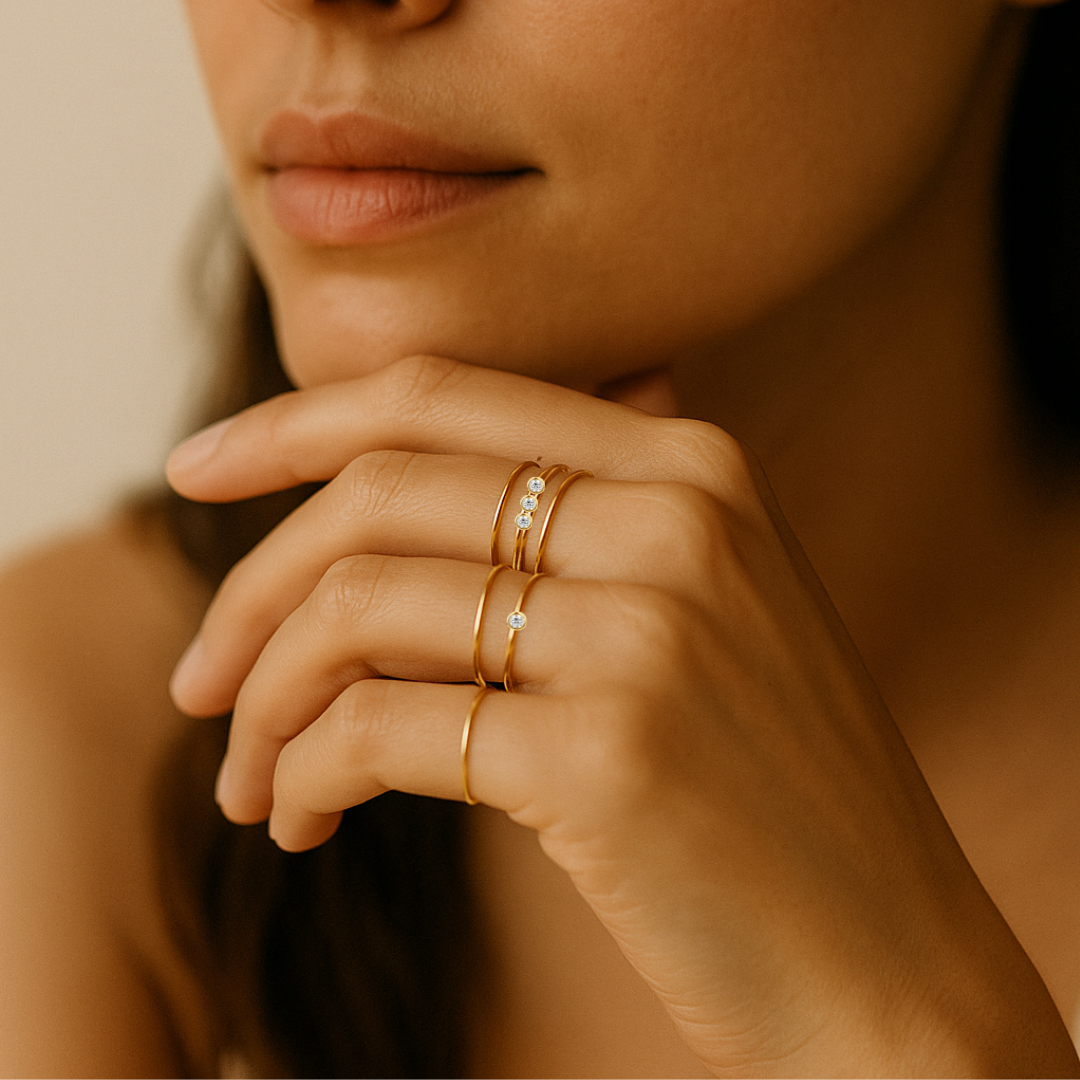
20% off Stacking Rings
Mix & Match!
Enjoy 20% off when you purchase 3+ rings with code STACKTHREE..
STACKTHREE

If you've ever noticed a small medal resting at someone's collarbone, there's a good chance it was a Virgin Mary necklace. For centuries, people have worn it as a sign of faith, protection, and comfort, and it remains one of the most meaningful pieces of religious jewelry you can own or give.
The meaning has stayed the same, but the necklace itself has changed with each generation. In the Middle Ages, believers carried simple medals of Mary, often blessed by a priest, while travelling or during illness. Today a Virgin Mary pendant can be a dainty gold filled oval made for layering or a detailed heirloom medal in solid gold. That range is why it suits a teenager's everyday outfit as naturally as a grandmother's lifelong keepsake.
In this guide, you'll learn what the necklace symbolizes, who traditionally wears it, and how to choose and style one at every age without losing its significance.

A Virgin Mary necklace is a piece of religious jewelry featuring a pendant or medal of the Blessed Virgin Mary, worn as a visible sign of faith, devotion, and protection. Put simply, it's a chain that carries Mary's image close to the heart, and it quietly tells the world, and reminds the wearer, what they believe and where they turn for comfort.
Each part of that definition matters. As religious jewelry, it belongs to the same family as crosses, crucifixes, and saint medals: pieces worn first for meaning and second for style. The pendant or medal is the heart of the necklace. A pendant can be any shape that bears Mary's image, while a medal is usually a flat, coin-like disc with an image on one or both sides and often a short prayer around the edge. And because it rests at the neckline, the necklace is a visible sign of faith, something others may notice and something the wearer can touch during the day as a reminder to pray.
The image itself carries meaning too. A Virgin Mary pendant usually shows Mary in prayer, cradling the infant Jesus, or standing with rays of light falling from her open hands. That last design is the Miraculous Medal, based on visions Saint Catherine Labouré reported in Paris in 1830, and it's likely the most widely worn Marian medal today. Its front carries the prayer "O Mary, conceived without sin, pray for us who have recourse to thee." Other necklaces Virgin Mary devotees treasure feature Our Lady of Guadalupe, beloved in Mexican families, or Our Lady of Fatima, linked to the apparitions reported in Portugal in 1917.
Shapes range from ovals and round coins to scalloped medals with lace-like edges, and materials run from stainless steel to solid gold. Many modern pieces are double-sided, with the Miraculous Medal's cross, "M," and two hearts on the back, so there's no wrong way for the pendant to land.
For Catholics and Orthodox Christians, Mary is a spiritual mother who prays for believers. Wearing her image is a nudge to pray, a comfort in hard seasons, and a quiet sense of protection. It isn't a good-luck charm: Catholics treat a blessed medal as a sacramental, something that turns the heart toward God rather than working on its own.
The necklace also carries family and cultural weight. In many Catholic families, from Mexico to the Philippines to Italy, a Marian medal is a traditional baptism gift, which means that for some people it is the very first piece of jewelry they ever owned. That's why the same medal is often worn from childhood into adulthood, then passed on.
The personal layer matters just as much. For one person it's Grandma's medal; for another, it marks a baptism, a recovery, a new baby, or a promise made during a difficult time. Two people can wear identical pendants for completely different reasons, and both are equally valid.
Faith doesn't have an age limit, but taste, lifestyle, and comfort change as we grow. A teenager wants something light that layers easily; a working professional needs a piece that looks polished in a meeting; a grandmother values a medal that's comfortable to wear daily and meaningful to pass on. The four groups below aren't strict rules. Treat them as starting points, then adjust for the wearer's personality and how often they'll wear the necklace.
Go small: an oval around 9 x 13mm or a coin under 15mm on a 16-inch chain. Layer it with an initial pendant or a paperclip chain over tees and denim. Pick a durable metal, because this necklace goes everywhere.
Gold filled or sterling silver is a smart middle ground at this age: tough enough for showers and sports, affordable enough that a lost necklace isn't a disaster. Many younger wearers also like a pendant that reads as modern from a distance, such as a small coin or oval, with the traditional image visible only up close.
A Virgin Mary gold necklace on an 18-inch cable or box chain moves easily from a morning meeting to dinner. If you layer, stop at two pieces spaced about two inches apart.
A pendant between 12 and 18mm reads as intentional without competing with a collar or lanyard. Yellow gold pairs warmly with neutrals, navy, and camel, while sterling silver looks crisp with black, grey, and cool tones. A medal with a thin polished border catches the light without needing stones.
A larger 20–22mm medal or a decorative border earns its place here. Let it be the single focal point over a solid knit, blouse, or simple dress.
For dresses and formal outfits, an 18–20 inch chain lets the medal sit just below the collarbone. Many parents also add personal meaning, such as a small initial charm for each child or a tiny cross on the same chain, turning the necklace into a story of faith and family.
Traditional Miraculous Medal or Guadalupe designs in solid gold or sterling silver suit pieces meant to be passed down. A 20-inch chain slips on easily, and a magnetic clasp converter helps stiff fingers.
Look for a solid bail and a sturdy cable or rope chain that won't kink, and choose a medal with deep, clear relief so the image stays easy to see. If the necklace is destined to become an heirloom, write down where it came from and why it matters. That story becomes part of what's handed down.
Choosing well comes down to five decisions: pendant size, chain length, metal, design style, and build quality. Get these right and the necklace will suit the wearer for years; get one wrong and even a beautiful medal can end up in a drawer. Here's how to think through each one.
Millimeters are hard to picture online, so compare against U.S. coins:
| Pendant size | Coin comparison | Best for |
|---|---|---|
| Under 15mm | Smaller than a dime (17.9mm) | Children, layering, minimalists |
| 15–20mm | Roughly dime-sized | Everyday adult wear |
| 20–25mm | Between a nickel (21.2mm) and a quarter (24.3mm) | Statement and heirloom medals |
As a rule of thumb, petite frames and children suit pendants under 15mm, while broader shoulders carry 20mm-plus medals comfortably. For reference, Le Serey's Virgin Mary designs span exactly this range: a 9 x 13mm oval, a 15mm coin, and a 22mm scalloped medal.
Match the chain's thickness to the pendant's weight. A fine 1mm cable chain suits a small oval, while a heavier medal needs a sturdier cable, rope, or box chain so it doesn't twist, flip, or strain the links.
The metal decides whether it lasts a season or a lifetime.
Buying a confirmation gift you hope she'll still wear at 30? Skip plating. That choice matters more than the design.
Before buying, look closely at the details. The image should be crisp and well defined rather than blurry. The ring connecting the pendant to the chain should be soldered closed or replaced by a solid bail, and the clasp should be a secure spring ring or lobster clasp. A quality stamp such as 14K, 925, or 1/20 14K GF confirms the metal. Clear product descriptions that state the metal, pendant size, and chain length are a good sign the seller stands behind the piece.
Wondering what types of necklaces are in style right now? The strongest trends are intentional layering, mixed metals, and pendant necklaces that carry personal meaning. Even long pendant necklaces are back on 2026 runways, and a faith medal fits all of these naturally.
Necklines matter too. Crew necks and button-down shirts suit 16–18 inch chains that sit above the collar, while V-necks and scoop necks frame a longer chain. Under a turtleneck, a 24-inch chain worn outside the knit keeps the medal on show.
Good care keeps the image crisp and the finish bright, which matters most on a piece you wear every day. The right routine depends on the metal.
A Virgin Mary necklace is one of the few gifts that can be worn every day for decades. It says "I'm thinking of you and praying for you" without needing words, which is why it's chosen so often for milestones of faith and family. Match the piece to the moment:-
To make the gift personal, consider the recipient's tradition, their everyday style, and whether they'd like the medal blessed before giving. A short handwritten note explaining why you chose it often becomes part of the keepsake.
The right Virgin Mary necklace suits both the wearer's style and the meaning they attach to it. Ask who will wear it, how often, and how long it should last, and the size, chain, and metal follow.
Trends will keep shifting. Chains get chunkier, then daintier again, and layering rules change every few seasons. The image of Mary doesn't. That's why the safest choice is a design you'd still reach in ten years, in a metal sturdy enough to get there. A classic oval or coin rarely looks dated, and it adapts to each stage of life: layered at 16, worn alone at 40, and handed down at 70.
Whatever you choose, let the meaning lead and the styling follow. A medal worn every day, through ordinary mornings and hard seasons alike, gathers a story no new piece can match, and that story is what turns a necklace into an heirloom.
If you're comparing options, the Le Serey Virgin Mary necklace collection shows the oval, coin, and scalloped sizes side by side in gold filled and sterling silver. From a teenager's first pendant to a medal passed to a granddaughter, choose one made to be worn for a long time
Faith, maternal protection, comfort, and trust in Mary's prayers, often alongside family heritage. For many wearers, it's also a daily reminder to pray.
Sixteen inches sits at the collarbone, 18 is the most versatile, and 20 to 22 suits larger medals. Choose based on pendant size and the necklines you wear most.
Solid gold, gold filled, and sterling silver handle daily wear and water; plated pieces don't. Rinse after chlorine or salt water and dry the chain before storing it.
The outer layer is real karat gold, at least 1/20 of the total weight. It isn't solid, but it's far thicker than plating and holds its color much longer.
It isn't required, but many Catholics ask a priest to bless it before the first wear. The metal makes no difference, and most priests are happy to bless a medal after Mass.
Use chains at 16, 18, and 20 inches, put the medal on the middle or longest strand, and keep other pendants smaller. Sticking to one metal tone keeps the stack looking intentional.
Yes. No church rule limits who may wear one. The only guideline is respect: wear it because the image means something to you, not as an ironic accessory. A family keepsake or a symbol of motherhood is a sincere reason too.
Join our newsletter for exclusive offers, new arrivals, and insider updates.
*By submitting your email, you agree to receiving promotional content. You can unsubscribe at any time. Offer on your first order over $100.